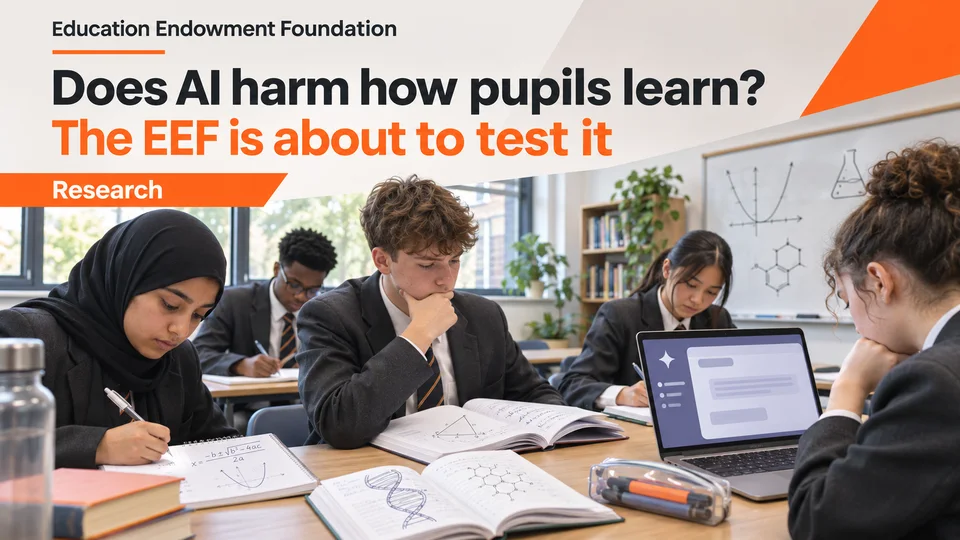
There's a widely held belief that AI is bad for learning. Pupils let ChatGPT do the thinking, and their own reasoning slowly wastes away.
It's a fair worry. But so far, much of the debate has run on speculation.
The EEF wants to change that. It has launched three randomised controlled trials that put "cognitive offloading", where pupils hand thinking tasks to AI, to the test. Does it free pupils up to think more deeply, or does it let them skip the mental effort that learning needs?
The trials are part of an EEF funding round to get quick evidence on what using AI does to pupils' learning.
The EEF says the studies will pay particular attention to pupils from socio-economically disadvantaged backgrounds.
The three trials
All three are open to state-funded mainstream secondary schools in England, at no cost. And each one assesses pupils afterwards on what they've understood and retained. That's the detail I'd watch.
Year 9 maths homework (Verian)
Verian will evaluate Google Gemini's Guided Learning, which talks pupils through a problem step by step instead of giving the answer, over six weeks of Year 9 maths homework. Classes using it are compared with classes getting their usual homework support, and an in-class assessment at the end measures maths knowledge and understanding.
Up to 51 schools can take part. They need to use Google Classroom and switch on the Gemini app for Year 9 maths pupils and teachers.
Read the Year 9 maths trial details and register interest on the EEF website.
Year 10 GCSE science revision (Behavioural Insights Team)
The Behavioural Insights Team will compare three approaches to a Year 10 Double Award Science revision lesson: guided AI (Copilot's Study and Learn or Gemini's Guided Learning), standard Copilot or Gemini, and no AI. Pupils sit a short closed-book online test about a week later.
Up to 63 schools can take part, and each needs at least three Year 10 Double Award Science classes taught by different teachers. Sign-up closes on 22 January 2027.
Read the Year 10 science trial details and register interest on the EEF website.
Year 9 biology and offloading judgement (University of Leeds, UCL and NatCen)
The University of Leeds, with University College London and the National Centre for Social Research, will compare Year 9 biology learning with and without AI tools across three lessons. Pupils sit an unaided test at the end of each lesson, then a retention test two to three weeks later.
A specially designed task will also measure how well pupils judge when to rely on their own thinking and when to use AI.
Up to 20 schools can take part, with a minimum class size of 17. Schools can't join both Year 9 trials.
Schools need suitable computer or laptop access and reliable internet, and will support pupil assessments and surveys. The research is planned for spring and summer 2027.
Read the Year 9 biology trial details and register interest on the EEF website.
My take
The question is the right one. We've spent three years arguing about whether AI helps or harms learning, mostly on instinct.
The science trial is the one I'm most interested in, because it separates guided mode from a standard chatbot. Microsoft and Google have both built learning modes that ask pupils questions instead of handing over answers. If guided mode holds up and the open chatbot doesn't, schools get a clear steer on which settings to switch on.
Testing pupils afterwards is the other thing I like. Doing well while the tool is open tells you nothing about what's left in a pupil's head a week or more later. If offloading is a problem, that's where it will show up.
I'll also be watching the Leeds, UCL and NatCen trial closely. Knowing when to reach for AI and when to do the thinking yourself is the skill we actually want pupils to leave school with. If it can be measured, it can be taught.
There are limits. These are short trials, and the longest runs for six weeks of homework. They won't tell us what years of daily AI use does to a young person's learning. And the first report, on the science trial, isn't due until autumn 2027, with the other two following in spring 2028. The tools will have changed again by then.
But it's a start, and it'll be evidence from English classrooms.
What to do now
- If you lead a secondary school, check the EEF's project pages for eligibility and how to sign up. Each trial has its own requirements.
- Talk to your IT team early. The maths and science trials use Gemini or Copilot through school-managed accounts, so someone needs to check which tools and guided modes are switched on for pupils.
- In the meantime, look at how your pupils use AI for homework. Are they asking it to explain, or asking it for the answer?
Would you put your Year 9s or Year 10s forward for one of these trials, or would you rather wait for the results?