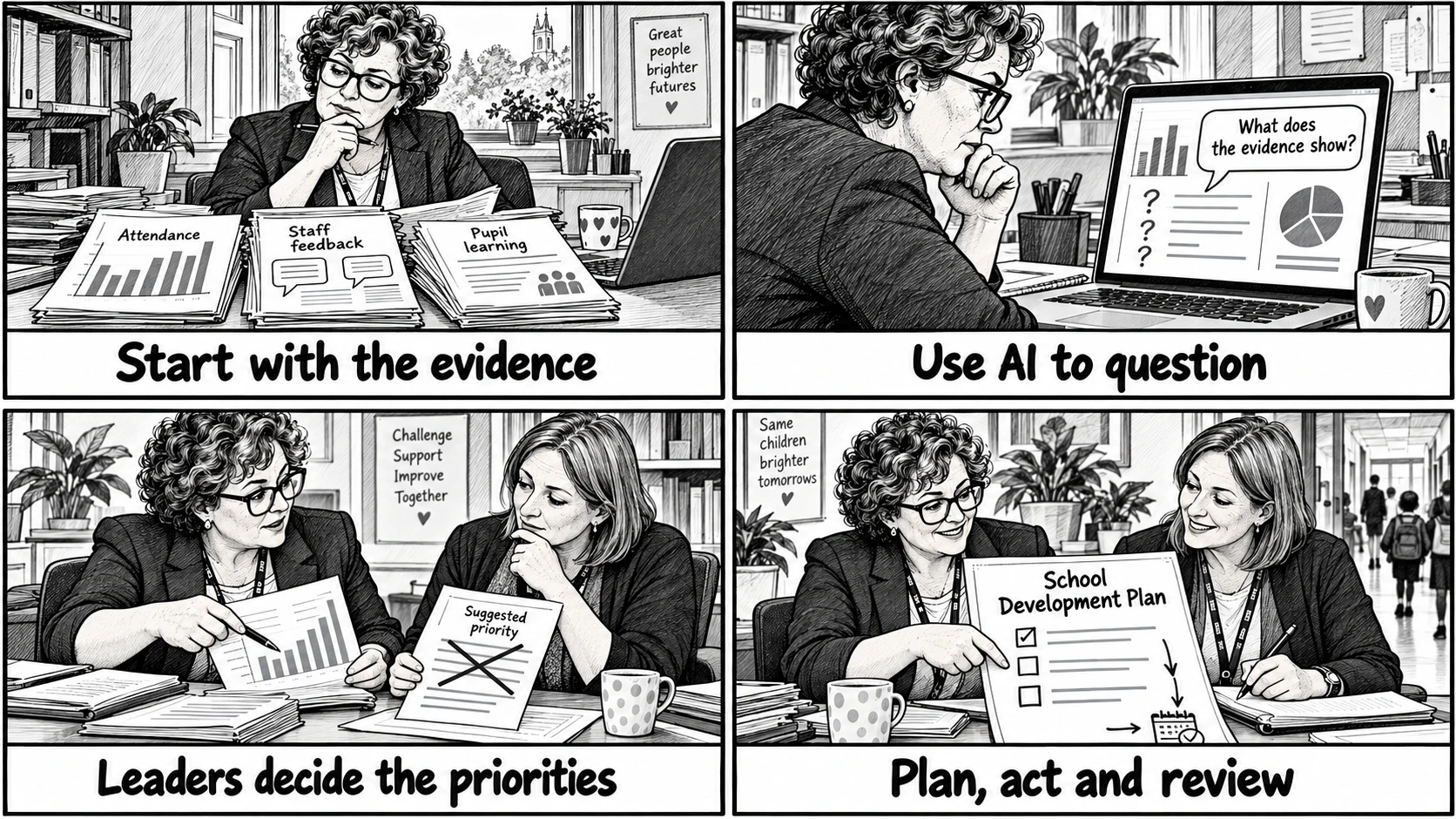
Mike Ion has published a free 25-page guide for senior leaders on using AI to build a self-evaluation and School Development Plan. Its first rule is the one most people will skip: keep AI away from the SDP template until the evidence is in.
Start with the evidence
The obvious prompt is "Write me a School Development Plan." It'll give you something that reads well and could belong to almost any school in the country.
Mike Ion's guide goes the other way. His opening move hands AI the school's evidence and asks it to analyse it critically, spot patterns and contradictions, then come back with the questions leaders need to answer before they choose any priorities.
So AI does the questioning. Leaders do the deciding.
What's in the guide
The guide runs to 16 parts and 12 prompts, plus a master prompt that strings them together. It follows one loop: gather, analyse, challenge, prioritise, plan, implement, evaluate, refine.
Part 1 is a checklist for an evidence folder. Outcomes, pupil groups, attendance and behaviour, quality of education, inclusion and leadership each get their own list, from question-level analysis through to staff surveys and the previous SDP.
It also covers data protection up front. Strip out names, dates of birth, safeguarding detail, medical information and individual SEND reports before anything goes near a public AI tool. Use "Pupil 1" or aggregate figures instead.
From there the prompts work through context, forensic analysis, root causes, prioritisation, writing priorities, stress-testing actions, implementation roadmaps and termly review. Each one tells the AI what to hold back on, such as "do not recommend priorities yet". Those limits do a lot of the work.
Four ideas worth stealing
Prove me wrong. Give AI your own reading of the evidence and ask it to disprove it. It looks for assumptions, contradicting evidence, other explanations and correlation passed off as causation. AI tools tend to agree with whoever's typing, so this prompt points them the other way.
Five whys. Year 10 attendance at 87% is a symptom. Mike's example traces it back through persistent absence and specific pupils to weak belonging and poor relationships with particular subjects. The SDP priority might end up being belonging or behaviour, with attendance as one of the measures.
Implementation and impact are measured separately. Every priority gets success criteria at three levels: what changes for pupils, what adults do differently, and what evidence shows it's working. The termly review prompt won't give a green RAG just because actions are complete. A finished action can still change nothing for pupils.
The red team. Before governors see the plan, ask AI to attack it as an external adviser would. The prompt ends with one question: if that adviser visited in six months, what would they most want to know?
My take
This is one of the more grounded guides on AI in school leadership I've read this year. It casts AI as the awkward colleague who keeps asking "how do you know?", and the prompts are ready to copy.
I'd add two things before anyone tries it.
First, tool choice. The guide is right to warn against pasting personal data into a public AI tool. But anonymising a small school's data takes more than swapping names for numbers. "One Year 3 pupil known to social care" can identify a child in a one-form-entry primary. Use the AI tool your school or trust already licenses with data protection terms in place, check it's covered in your DPIA, and leave out small-group figures unless you're sure they can't point to an individual.
Second, the 90 minutes. Part 15 lays out a 90-minute AI self-evaluation session. The analysis might fit in that window. Building the evidence folder from Part 1 won't, and everything after it depends on that folder. A thin folder gets you a confident analysis of very little.
Mike's last golden rule says the final evaluation belongs to school leaders. I'd pin that one above the screen. AI is quick at producing text that sounds like judgement, and a governor reading it can't tell which parts a leader actually tested.
Over to you
If you've used AI anywhere in your self-evaluation this year, where did it help, and where did you have to overrule it?
The guide is free and written by Mike Ion, author of Values in Action: A Compass for School Leaders. If you'd like a copy, contact Mike directly on LinkedIn.
Sources
Mike Ion, AI for School Improvement: A Free Guide for Senior School Leaders, October 2026 (copies available from Mike via LinkedIn) Mike Ion on LinkedIn