Open an AI model selector and the list can look more like a celestial catalogue than a toolkit: Astra, Sol, Terra and Luna, with different version numbers alongside them. It’s tempting to leave the default selected for everything, or choose the biggest model because it sounds like the safest bet.
Neither approach is a reliable rule. OpenAI’s own guidance recommends GPT-6 Astra for the most demanding work, GPT-6.1 Sol for complex work at lower cost, GPT-6.1 Terra for visual reasoning and writing, and GPT-6 Luna for focused, high-volume tasks. OpenAI’s model guidance is a useful starting point.
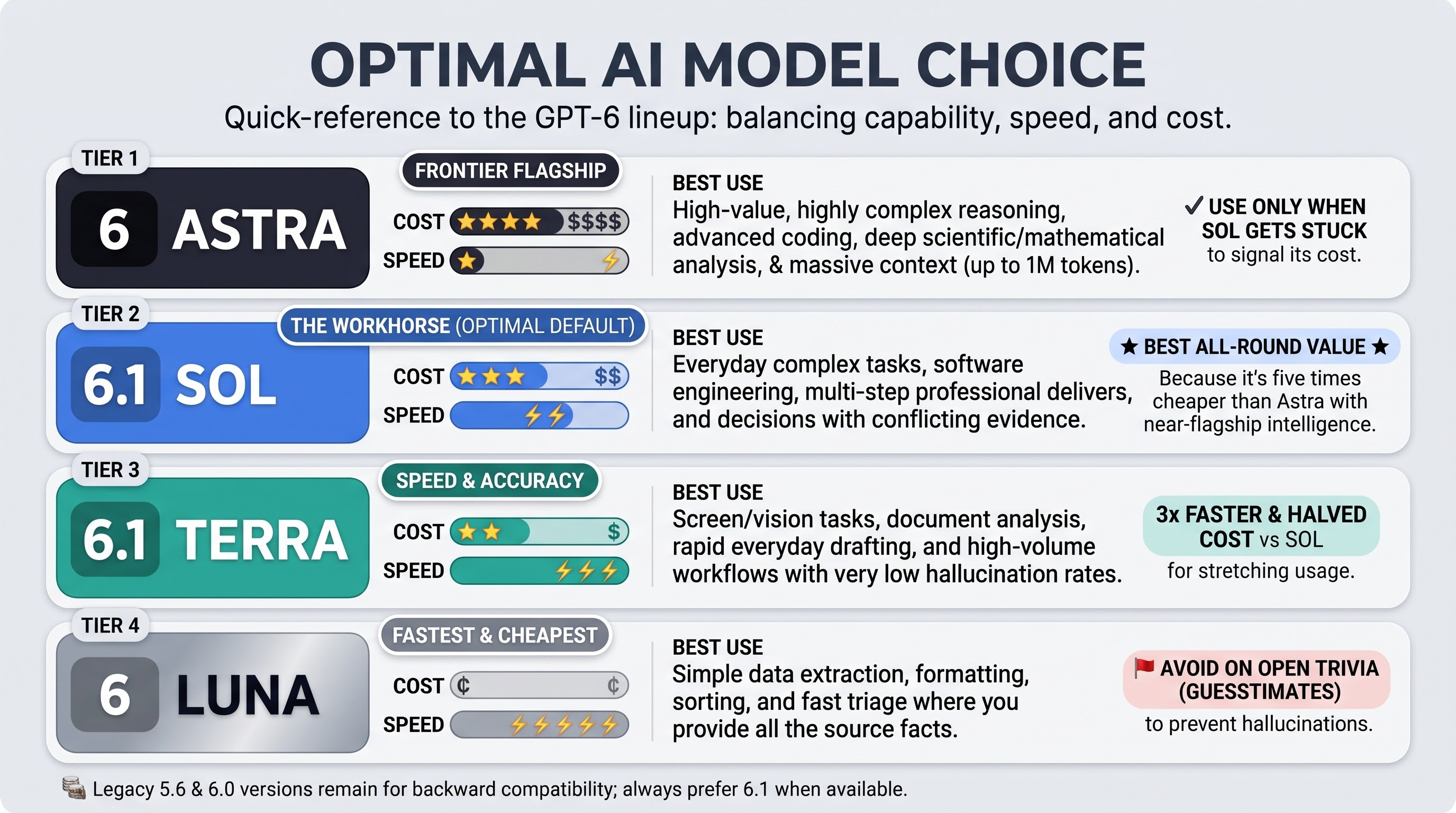
Four models, four different jobs
GPT-6 Luna is aimed at focused, high-volume work. It can suit routine tasks such as sorting information you’ve supplied, extracting details from notes or reformatting text. Its low API price can make it useful for automated workflows, but that doesn’t make it the right choice for every question. Give it suitable source material and check important outputs, especially when accuracy matters.
GPT-6.1 Terra is designed for visual reasoning and writing. It can be a good fit for working with screenshots, reviewing documents or drafting routine communications. OpenAI reports improvements in Terra’s factuality tests compared with the previous Terra model, but benchmark results aren’t a guarantee that any answer will be correct. See OpenAI’s GPT-6.1 Terra announcement for the evaluation details.
GPT-6.1 Sol is intended for complex work at lower cost than Astra. Consider it for tasks that need several steps of reasoning, detailed drafting or coding, where a lightweight model may struggle. OpenAI places it between Terra and Astra for this kind of work.
GPT-6 Astra is the flagship option for the most demanding tasks. It may be worth using when a problem is unusually difficult, ambiguous or has several interacting parts. For simpler work, the extra capability may not make enough difference to justify the additional usage or API cost.
What does “cost” mean here?
For organisations using the API, the published standard rates make the difference clear. Per million input and output tokens, OpenAI lists GPT-6 Astra at $10 and $50, GPT-6.1 Sol at $2 and $10, GPT-6.1 Terra at $1 and $5, and GPT-6 Luna at $0.10 and $0.50 respectively. Actual bills depend on how much the model reads and generates, plus any applicable tools or pricing options. Check OpenAI’s current API pricing before estimating costs.
Those figures apply to API usage. ChatGPT Work and Codex use plan-based allowances, so the API prices shouldn’t be treated as a direct estimate of what an organisation will pay for those products. OpenAI says GPT-6.1 Terra uses less of the allowance per task than GPT-6.1 Sol or GPT-6 Astra in ChatGPT Work and Codex.
A practical way to choose
For everyday work, start with the model that meets the task’s needs without adding unnecessary complexity:
- Use Luna for mechanical, high-volume tasks with clear instructions and supplied information.
- Try Terra for document and image work, routine writing and tasks where speed matters.
- Choose Sol when the work needs more involved reasoning or detailed output.
- Move to Astra when the problem is difficult enough to benefit from deeper reasoning.
For example, extracting dates from a batch of supplied notices may suit Luna. Summarising a policy document or interpreting a screenshot may suit Terra. Comparing options against several requirements may call for Sol. A tangled problem with incomplete information may justify trying Astra.
These are starting points, not guarantees. The right choice depends on the task, the material provided and the quality of the result. For important work, check the output against its sources and compare models using representative examples from your organisation.
The best default is a decision, not a badge
The largest model in the menu isn’t automatically the best model for every job. A sensible default is the one that handles your common tasks well, while leaving room to move up when the work calls for it.
Treat the selector like a gearbox: choose for the work in front of you, then change gear when the task demands it.